
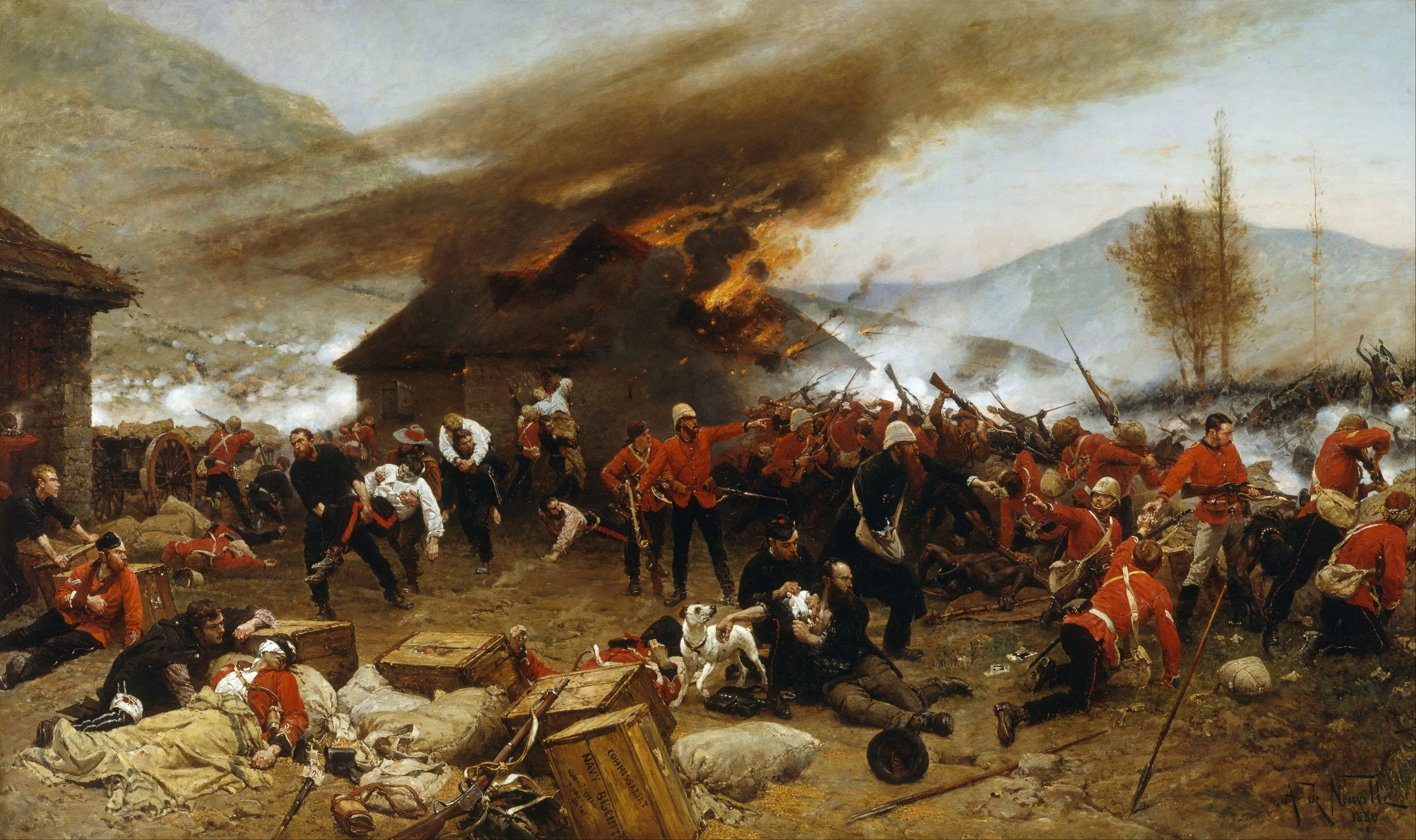
Rorke’s Drift
A Regimental Tribute
“The loss of any life on active service is a matter for regret, the more so if the cause for which that soldier died was unjust. There can be no doubt that the causes of the Anglo Zulu War in South Africa in 1879 were not just, but we remember with immense pride, honour and humility, those officers and soldiers of the 24th Regiment of Foot who gave their lives at the Battle of Isandlwana and in the Immortal Defence of Rorke’s Drift in Zululand, on the 22nd and 23rd January 1879.
The first major defeat of the Zulu War took place when 20,000 warriors of King Cetshwayo’s mighty army swept down upon the unsuspecting soldiers of the 1st Bn the 24th Regiment of Foot, as they camped beneath the hill of Isandlwana, which bore an uncanny resemblance to the Sphinx on the collar badges of their uniform. At first, the heavy volley fire from the disciplined ranks of the Regiment held the opposing force in check, but within a few short hours the position had been over-run by the Zulus, not because of a shortage of screwdrivers to open the ammunition boxes, but because it was just not possible to replenish the Companies fast enough in the face of such overwhelming odds. Some of the auxiliary troops broke and ran in sheer terror, but to a man the rifle companies of the 24th Regiment of Foot stood their ground and fought to the bitter end. A soldier may fight for Queen and Country, but man can die no better than when he lays down his life for his friends, epitomised by the fact that, of the 600 men of the 24th Regiment of Foot on the battlefield that day, only six were to survive.
When it became apparent that the battle was all but lost, Lieutenants Melvill and Coghill attempted to save the Queens Colour from falling into enemy hands. There is no glory in the act of war itself, but the Colours embody the honour, pride, tradition and ethos of a Regiment, so it is no surprise that they were willing to risk their lives in such an attempt. Pursued by the Zulus along what is now known as the Fugitives Trail, Lieutenant Coghill was first to reach the safety of the home bank of the Buffalo River, but on seeing Lieutenant Melvill in difficulty with the Colour, he had no hesitation in plunging back into the river to help his friend. Some years later, they were both among the first ever to be awarded the Victoria Cross posthumously, such was the highest regard given to their selfless act of courage.
Later that day, 4,000 warriors of the reserve force of the Zulu army, led by Prince Dabulamanzi, attacked the temporary hospital and stores depot, now housed in the former Swedish missionary station some 10 miles away, close to the river crossing known as Rorke’s Drift. Defended by just 100 men of B Company the 2nd Bn the 24th Regiment of Foot, and commanded by Lieutenant Gonville Bromhead, their heroism in holding out against wave after wave of frenzied attacks throughout the night is enshrined in the annals of British military history. Although romantically dramatised by that highly popular film, Zulu, in reality we can only imagine the ferocity of the fighting that took place that night, and we pay tribute to those who paid the ultimate sacrifice and recall with quiet pride the seven Victoria Crosses awarded to those members of the Regiment who would have been concerned only with saving the lives of their comrades in arms.
The echoes of that war have long since faded away, but the memory lives on, marked by the presence here today of so many Regimental comrades, friends and dignitaries, all of whom are most welcome. We are particularly pleased to have with us the Mayoress of Brecon, representing not only the people of Brecon but also the strong links which exist between the Regiment and the Town. We are also honoured to be able to commemorate this unique event each year in the Cathedral by kind permission of the Dean, without whose generous support this Service would not be possible.
Brecon Cathedral has long been the custodian of the noble heritage of the 24th Regiment of Foot, witnessed by the Regimental Colours and the Wreath of Immortelles laid up in the Havard Chapel, the main east window and the many brass and marble memorial tablets on the Cathedral’s walls. When the Regiment returned to England, Her Majesty Queen Victoria placed a floral wreath of immortelles on the Colour and decreed that this should be carried for evermore by the Regiment in honour of all those who had lost their lives during the Zulu wars. This distinction is unique throughout the British army and it is one which we acknowledge with respect and appreciation. The Zulu War Colours were laid up in this Cathedral on Easter Day in 1934 and I am honoured that my great uncle was one of the two officers who carried the Colours on that occasion.
In the last 145 years, the Regiment has seen much change, and is now known as The Royal Welsh. You may be sure that the golden thread of our Regimental history will accompany those who forge ahead on their new journey and that the legacy of the Battle of Isandlwana and the Immortal Defence of Rorke’s Drift will remain in good hands.”